
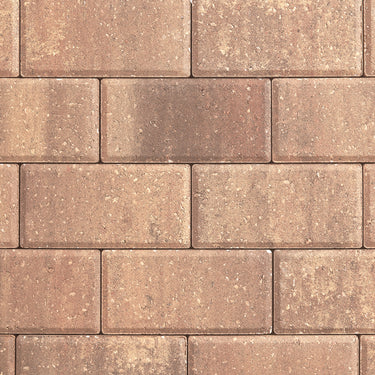


Compare Tremron’s 4" × 8" Permeable Paver in person before choosing material for your project. Select your preferred color and available finish to evaluate its appearance alongside your home, landscaping, or existing paving.
What you receive
One whole 4" × 8" × 3⅛" (80 mm) paver per sample ordered, in the selected color and finish. This is a physical material sample, not a complete paving system.
Color and finish
Each piece represents one example of the selected color. Blends vary between pieces and production runs; a single sample cannot show the full range or guarantee an exact match to existing paving.
Larger samples and special requests
For multiple pieces to compare a blend, alternate sizes, or mock-up quantities, email us with your requirements and delivery ZIP code before ordering. We’ll confirm availability and any additional sourcing, packaging, or shipping charges.
USDC Coming Soon

Home Work
Permeable & Pervious Explained
Sizing Guide
Understanding Permeable Paver Systems
What is Permeable Interlocking Concrete Pavement (PICP)?
PICP is a stormwater management solution that allows rainwater to filter through the joints between pavers, down through engineered aggregate layers, and into the soil below — reducing runoff, flooding, and pollution.
How the System Works
PICP is not just a surface material — it's a layered drainage system. From top to bottom:
- Pavers – Solid concrete units (3⅛"/80mm thick) with open joints filled with No. 8, 89, or 9 stone aggregate
- Bedding Layer – 2" ASTM No. 8 stone beneath the pavers
- Base Layer – Min. 4" ASTM No. 57 stone for structural support
- Subbase Layer – Min. 6" ASTM No. 2 stone for water storage and drainage
- Geotextile Filtration Fabric – Placed on the bottom and sides of the open-graded base (when required by a design engineer) to prevent soil migration
- Subgrade – Prepared native soil; depth and conditions determined by geotechnical analysis
Pedestrian-only applications may simplify to a single 6" ASTM No. 57 base layer.
Manufacturing Standards
Permeable concrete pavers are manufactured to meet:
- ASTM C936 – Solid Concrete Interlocking Paving Units
- ASTM C1782 – Segmental Concrete Paving Slabs
- CSA A231.1/A231.2 – Canadian standard for precast concrete pavers and slabs
Key Uses & Applications
- Driveways, parking lots, plazas, and pedestrian walkways
- Low Impact Development (LID) stormwater strategies
- Areas subject to local stormwater regulations or impervious surface limits
- Sites needing reduced heat island effect or improved groundwater recharge
Important Design Considerations
- Subbase depth must be determined by site-specific hydraulic and structural engineering — not a one-size-fits-all spec.
- Traffic loading affects paver dimensions and aspect ratios — consult a structural engineer for vehicular applications.
- Geotechnical input is required to balance structural stability with soil infiltration rates.
- Geotextile selection must be verified against clogging resistance and must meet AASHTO M-288 requirements.
- Stone substitution – ASTM No. 2 stone in the subbase may be substituted with No. 3 or No. 4 stone where appropriate.
Maintenance & Long-Term Performance
All permeable pavements collect sediment over time, gradually reducing infiltration rate. This is expected and manageable:
- Sediment accumulates near the surface where it's easiest to remove
- Routine vacuum street sweeping is the primary maintenance method
- Surface infiltration testing should confirm rates exceed 100 in/hr after any major maintenance or restoration
- A site-specific Operations & Maintenance (O&M) Manual is recommended for commercial and municipal installations
Construction Site Protection Tips
Protecting a newly installed PICP system during ongoing construction is critical:
- Schedule PICP installation strategically — early installation allows it to serve as a sediment trap, with joint material replaced at project completion
- Avoid washout and debris from concrete, masonry, and drywall trades directly on the paver surface
- A sacrificial asphalt layer over the base aggregate can protect the system during heavy construction traffic, but must be removed and the base re-graded before final paver installation
- Plywood, tarps, and fabric covers have generally proven costly and ineffective as surface protection
Permeable vs. Pervious — What's the Difference?
These terms are often used interchangeably, but they describe two distinct pavement technologies. Understanding the difference helps designers and contractors select the right system for each project.
| Permeable Pavers (PICP) | Pervious Concrete | |
|---|---|---|
| How water moves | Through open joints between solid paver units | Through internal voids within a monolithic poured slab |
| Surface material | Individual precast concrete units | Poured-in-place concrete with reduced fine aggregate |
| Repairability | Individual units can be lifted and replaced | Full section removal and replacement required |
| Aesthetics | Wide range of colors, shapes, and patterns | Gray, utilitarian appearance |
| Freeze-thaw performance | Excellent — units flex independently | Vulnerable to cracking in freeze-thaw climates |
| Typical applications | Driveways, plazas, parking, pool decks | Parking lots, low-speed roadways, commercial pads |
| Maintenance | Vacuum sweeping; joint material can be replenished | Vacuum sweeping; clogged sections are difficult to restore |
About Pervious Concrete
Pervious concrete is a porous, poured-in-place pavement made with little to no fine aggregate, creating a high void structure (typically 15–25%) that allows water to pass directly through the slab surface. Like PICP, it relies on an open-graded aggregate base below for storage and infiltration.
Key characteristics:
- Void content: 15–25% by volume
- Infiltration rate: 100–1,000+ in/hr when new and unobstructed
- Compressive strength: typically 2,500–4,000 psi (lower than standard concrete)
- Best suited for light vehicular and pedestrian applications
- Not recommended in climates with heavy freeze-thaw cycles without careful mix design
When pervious concrete may be the right choice:
- Large, uniform commercial or municipal parking areas where aesthetics are secondary
- Projects with tight budgets where the lower installed cost of poured concrete is a priority
- Sites where a seamless, continuous surface is required by code or design
When permeable pavers are the better choice:
- Residential or high-visibility applications where color and design matter
- Any site where future utility access or repair flexibility is needed
- Freeze-thaw climates where pervious concrete durability is a concern
- Projects where long-term maintainability and infiltration restoration are priorities
For Florida applications specifically, freeze-thaw is rarely a concern — but repairability, aesthetics, and long-term maintenance favor permeable pavers in most residential and commercial settings.
Recommended Resources
- ASTM C936 Standard – Paver manufacturing specification
- AASHTO M-288 – Geotextile specification for filtration
- EPA Permeable Pavement Overview – LID stormwater context
- Interlocking Concrete Pavement Institute (ICPI) – Industry technical guidance and installer resources
Tremron - Terms & Conditions
*Special
Terms and Conditions of (1) Request for Credit and (2) Sale Agreed to by Seller and Buyer
1. Contract — Each order constitutes a binding contract between Buyer and Seller per the Terms and Conditions and Seller's invoice.
2. Terms — Seller's terms prevail at all times. Buyer's order blanks imposing conflicting conditions are not binding. All orders are accepted at Seller's General Offices, Florida.
3. Changes — No substitutions accepted without written approval. Color and texture may vary due to raw materials, weather, and manufacturing variance. Efflorescence may appear during the first two years and is not a defect.
4. Taxes — Prices exclude all applicable federal, state, and local taxes, which are the Buyer's responsibility.
5. Sales Tax Exemption — Sales Tax must be charged unless Buyer provides a current Florida Tax Certificate with Sales Tax Number.
6. Non-Compliance by Buyer — Seller may cancel any order without penalty if Buyer fails to comply with terms or make timely payment. Buyer is liable for all resulting damages and expenses.
7. Privity — Price quotations are directed solely to the named Buyer on the reverse side.
8. Transportation — All goods sold F.O.B. plant. Deliveries are made to curb line. Buyer assumes full responsibility for deliveries beyond the curb. Additional freight may apply for excessive waiting or unloading time.
9. Shipping Date — Shipping dates are estimates only. Seller is not liable for delays caused by circumstances beyond its reasonable control.
10. Requested Delays — If Buyer requests a delay in shipment, Seller is not responsible for loss or damage; material will be invoiced when ready to ship.
11. Special Orders — Special or fabricated orders require a deposit and are non-cancellable once full payment is made. Must ship within 45 days of production.
12. Special or Custom Colors — Buyer agrees to take full delivery of total quantity ordered plus pay $1,000.00 for any special color run, plus additional shipping costs.
13. Returns — Goods require written "Return Goods Authorization." Used, obsolete, or special orders may not be returned. Restocking charge of not less than 25%, plus freight. Materials delivered more than 30 days will not be credited. Tumbled materials, 1" materials, bullnose, opened bundles, and special color items are not accepted for return. Orders cancelled after production are subject to a 50% surcharge.
14. Specifications — Seller reserves the right to change specifications as conditions warrant.
15. Representations — No agent has authority to bind Seller to any warranty or representation unless in writing and included in the agreement.
16. Variances — All dimensions and weights are nominal and will vary within accepted standards. Square footage quantities vary by shape and are calculated on mold manufacturer's blueprints with an allowance for sand joints.
17. Warranties — Seller makes no warranty, express or implied, beyond standard quality. Implied warranties do not extend beyond one year. Liability is limited to replacement of stone only to the job site.
18. Inspection — Goods must be inspected upon delivery. Written notice of rejection must be sent within three (3) days of receipt. Use of any materials by Buyer constitutes acceptance.
19. Claims — Loss or damage must be reported within three (3) days of delivery. Buyer may not deduct any claim from an invoice until authorized by Seller.
20. Damages — Seller is not liable for special, indirect, incidental, or consequential damages. Buyer's exclusive remedy is the price difference between market price and contract price.
21. Solvency — Buyer represents solvency at time of delivery and must notify Seller upon becoming insolvent per FLA STAT. 671.201(23).
22. Reclamation by Seller — If Buyer fails to pay or becomes insolvent, Seller may reclaim all goods shipped.
23. Risk of Loss — Risk passes to Buyer when goods are tendered to the carrier.
24. Title — Title remains with Seller until Buyer pays in full.
25. Price — In the event of inconsistency between unit price and gross price, unit price prevails.
26. Payment — Buyer has 20 days from Seller's tender to carrier to make payment. Service charge of 5% of face amount or $25.00 applies to dishonored checks. All payments applied to oldest unpaid charges first.
27. Service Charges — Failure to pay within 30 days results in a 1.5% per month (18% per annum) service charge. Continued default may result in suspended deliveries.
28. Cash or Credit Card Payment — Seller may require cash or credit card payment before shipment. All C.O.D. orders must be paid by cash or certified check prior to shipment.
29. Attorney's Fees — Buyer agrees to pay all collection costs, including attorney's fees of not less than 15% of the balance due, and court costs.
30. Complete Agreement — This Agreement is the complete and exclusive statement of terms. Prior dealings are not relevant to supplement or explain any terms.
31. Renewal or Waiver — No term is waived unless in writing and signed by Seller.
32. Jurisdiction — Governed by the laws of the State of Florida. Venue shall be in the Florida courts.
33. Modifications — Agreement can only be modified in writing, signed by an officer of Seller.
34. Titles — Paragraph titles are for convenience of reference only.
35. Severability — Invalidity of any provision does not affect the validity of any other term or condition.
36. Ordering — Orders should include complete shipping information: company name, correct address, and zip code.
37. Freight — Orders should indicate desired method of shipment.
38. Copyright — No parts of catalogs or promotional materials may be reproduced without express written consent.
39. Installment Deliveries — Non-delivery of any installment is not a breach of the full Agreement and does not relieve Buyer of obligation to accept and pay for prior or subsequent installments.
40. Benefit — This Agreement is binding upon and inures to the benefit of the successors and assigns of the respective parties.
Installation Resources
Installation Resources
Find the tools, guides, and references you need to plan and install your paver system with confidence. Resources are organized by category below.
Pattern Libraries
Explore laying patterns for interlocking and permeable paver systems.
Installation Guides
Step-by-step installation documentation for various paver systems and applications.
- [Placeholder: PICP Installation Guide Link]
- [Placeholder: Standard Paver Installation Guide Link]
- [Placeholder: Permeable System Maintenance Guide Link]
Specification Sheets & Technical Data
Download product spec sheets, ASTM compliance documents, and engineering reference materials.
Design & Visualization Tools
Use these tools to plan layouts, visualize patterns, and estimate materials.
Industry & Regulatory References
Standards, codes, and industry organizations relevant to paver installation.
- Interlocking Concrete Pavement Institute (ICPI) – Industry technical guidance and installer resources
- EPA Low Impact Development (LID) Overview – Stormwater and permeable pavement context
- [Placeholder: Local Code / Municipality Reference Link]
Have a resource to suggest or need help finding a specific document? [Link to your contact page]
Contact Us
Get a faster, more accurate response — answer these before you hit send:
- Residential or Commercial?
- Use case — Overlay Install, Naked Earth Install, pool deck, driveway, walkway, patio, steps, wall, other?
- Approx. square footage (or linear feet for coping/wall)
- Timeline — ordering now / 1–3 months / 3–6 months / just planning
- Contractor or homeowner?
Feel free to attach photos, drawings, or any docs that help describe your project or situation — the more context, the better.
This email is the start of a real conversation. You might be surprised how quickly we engage.

